
Nano-microporous insulation materials leverage their nano-scale porous microstructure to deliver multiple advantages: ultra-low thermal conductivity, A1 non-combustibility, and heat resistance up to 1200℃, making them the core thermal protection material for passive fire protection systems across various industries.
What Is Nano-Microporous Insulation Material?WH nano-microporous insulation materials use nano-porous silica, infrared opacifiers, and high-temperature resistant inorganic fibers as core raw materials, formed as an integrated piece through a proprietary composite process.
The material is densely packed with a nano-scale microporous structure internally, which inhibits heat transfer through three mechanisms:
1. Blocking solid heat conduction: Ultra-fine nano powder elongates the heat transfer path, reducing solid-phase thermal conductivity;
2. Suppressing gas convective heat transfer: The micropore size is smaller than the mean free path of air molecules, weakening internal air convection;
3. Blocking high-temperature infrared radiation: Compounded with infrared opacifiers that reflect high-temperature thermal radiation, reducing radiative heat transfer.
With these multiple mechanisms working in tandem, the material's thermal conductivity is lower than that of still air, and its high-temperature insulation performance far exceeds that of traditional insulation materials, making it the ideal insulation substrate for energy storage and high-temperature fire protection scenarios.
High-Temperature Thermal Conductivity Comparison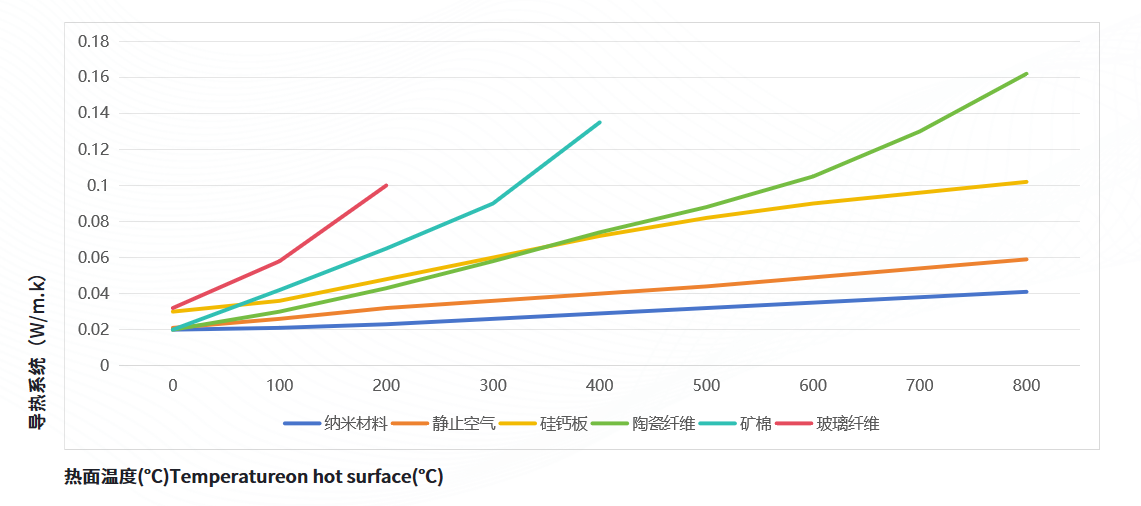
In the 500~1000℃ high-temperature range, the thermal conductivity differences among various materials are significant:
1. Calcium silicate boards, ceramic fibers, rock wool: Thermal conductivity soars as temperature rises, with high-temperature insulation rapidly failing;
2. Ceramic fiber aerogel: Moderate performance at low-to-medium temperatures, but thermal conductivity continues to rise above 800℃;
3. WH nano-microporous insulation board: Thermal conductivity remains consistently extremely low across the entire temperature range, at only 0.034 W/(m·K) at 800℃, with high-temperature insulation stability leading traditional materials.
Five Core Performance Advantages
1. Ultra-Low Thermal Conductivity, Thin Design Saves Equipment Space
Under the same fire protection and insulation specifications, WH nano-microporous insulation boards require only 1/4~1/5 the thickness of traditional materials to achieve the same insulation effect. With a high-temperature thermal conductivity as low as 0.034 W/(m·K) at 800℃, it is perfectly suited for space-constrained applications such as energy storage battery packs, prefabricated cabins, and rail transit equipment, enhancing fire safety ratings without expanding equipment volume.
2. A1 Grade Inorganic Non-Combustible, Comprehensive Global Fire Certifications
The product features a fully inorganic formulation, achieving the highest building A1 non-combustible rating and a flame retardancy rating of UL94 V-0;
Certified to international fire standards including EN 1363/1364-1, IMO 2010 FTP Code Part 1 , and others;
In the energy storage sector, it can successfully pass UL 9540A thermal runaway propagation testing and LSFT large-scale fire testing, fully meeting the fire safety compliance requirements for overseas energy storage power stations and power battery exports.
3. Maximum Temperature Resistance of 1200℃, Adaptable to Various Standard Fire Curves
The material can withstand long-term exposure to 1200℃ high temperatures and can stably respond to three major standard fire temperature rise curves:
· ISO 834 Standard building fire curve
· EN 1363-2 HC Hydrocarbon high-temperature fire curve
· UL 1709 Hydrocarbon rapid-rise fire curve
In extreme high-temperature fire scenarios, the board structure does not collapse or melt, maintaining the thermal insulation barrier for an extended period, providing ample safety protection time for equipment and personnel.
4. Thin and Lightweight, Reducing Overall Equipment Load
Compared to traditional heavy fireproof and insulation materials, WH nano-microporous insulation boards can significantly reduce the self-weight of cabinets, cabins, and vehicles, alleviating structural steel loading pressure while saving internal equipment space, thereby increasing energy storage installation capacity and new energy vehicle battery carrying capacity.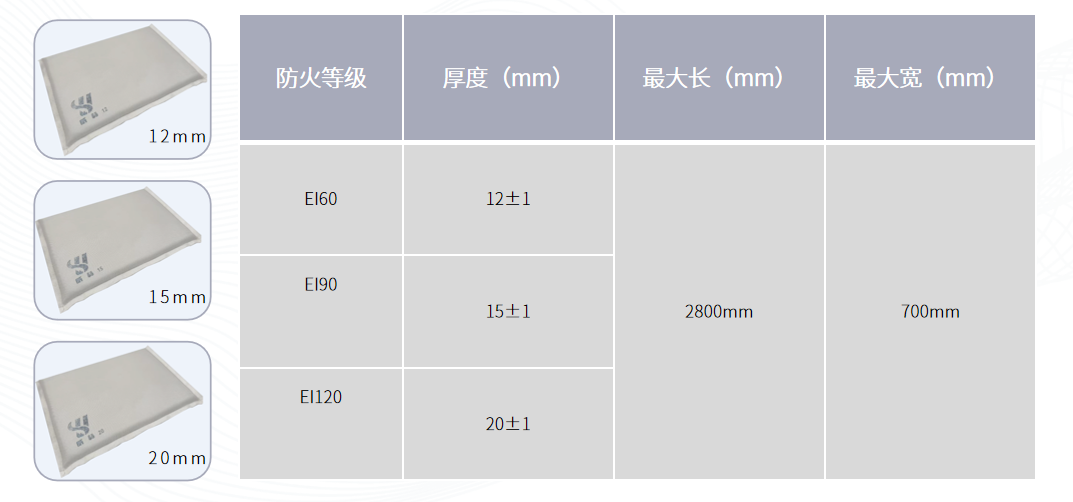
5. Inorganic and Eco-Friendly, Smoke-Free, Non-Toxic Combustion, and Easy to Recycle
Contains no organic combustible components; during a fire, it produces no thick smoke, no pungent odors, and does not release toxic or hazardous substances; complies with RoHS environmental control standards, and can be easily recycled and disposed of after disposal, meeting the environmental review requirements for green manufacturing and export projects.
Typical Applications Across All Industries
1. New Energy Storage Protection
WH nano-microporous insulation materials can be applied in:
· Thermal insulation and flame retardancy between power battery cells and modules, preventing cascading thermal runaway propagation from individual cells;
· Fire insulation for energy storage containers and storage cabinet enclosures, certified through UL9540 and LSFT large-scale combustion testing;
· All types of equipment for commercial & industrial energy storage, residential energy storage, and large-scale wind-solar energy storage power stations.
2. Building Passive Fire Protection
Suitable for fire doors, elevator landing doors, building fire partitions, and fireproof cladding for ventilation ducts, meeting the fire safety acceptance specifications for both civil and industrial buildings.
3. Transportation Sector
Fire protection for marine A class decks/bulkheads, railway vehicle fire doors and battery protection, aerospace vehicle battery insulation, and flight recorder high-temperature protection, addressing lightweight fire protection needs across land, sea, and air dimensions.
4. Industrial High-Temperature Facilities
Structural fire protection for nuclear power equipment, long-term thermal insulation for high-temperature industrial pipelines and ventilation ducts, isolating high-temperature heat dissipation, reducing equipment energy consumption, and eliminating the risk of high-temperature burns from outer shells.